Juliet says to herself “What’s in a name? That which we call a rose / By Any Other Name would smell as sweet.” from her balcony in Shakespeare’s Romeo and Juliet. She is lamenting the fact that she and her newly-discovered love, Romeo are from rival families. Their names–Montague and Capulet–seem to be, on the surface, the problem.
Romeo eavesdrops from below and when he cannot contain himself any longer, blurts out that he will discard his name so they can be together. But, it is their names that seal the fates of the “star-crossed” lovers.
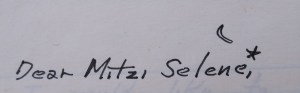
My dad named me. As the story goes, he wanted me to have an unusual name that wouldn’t be shortened. He was adamantly against nicknames. Sure, some people call me “Mitz,” but it’s rare and most people know better than to call me that. I’m often asked the origin of my name. I wasn’t named after a relative or family friend. There is no cultural significance that I know of. I’ve heard it’s German. Some say it’s Japanese (but as a Japanese nickname spelled differently). One thing is certain, it has been and remains an unusual name. I was the only Mitzi in school in a time and place where there were several Stacys, Lisas, Kathys, and Christinas in my classes. When I worked in positions that required a nametag, occasionally someone would tell me that they knew a Mitzi, but usually that Mitzi was a dog.
My middle name is Selene. There must have been some confusion about it though because my mom misspelled it “Seline” on my birth certificate. Before I started kindergarten she had it changed to the proper spelling. Traditionally it’s pronounced “Seh-lee-nee.” Selene is a moon goddess in Greek Mythology. The story goes that she fell in love with Endymion who was opted for eternal sleep in order to avoid aging. So Selene takes her chariot each night to visit him . . . as he is sleeping. Strange story. Perhaps stranger still to give this name to a daughter.

Front of a Sarcophagus with the Myth of Endymion. About A.D. 210 Image courtesy of The Getty Open Content Program
There is a portion of a sarcophagus on display at The Getty Center that depicts the story of Selene and her love Endymion. This is how it is described:
“On this fragment of a Roman sarcophagus, the mythological story of the love of Selene, the moon goddess, for the beautiful young mortal Endymion provides an allegorical message of hope for the deceased. In the center of the scene, Selene, identified by the crescent moon in her hair, alights from her chariot. Accompanied by Erotes, she approaches the sleeping Endymion. Hypnos, the god of sleep, stands behind Endymion, holding a branch of poppies and pouring sleeping potion over him; by these means, Endymion sleeps eternally, in order to remain with the immortal goddess. The youth’s tranquil sleep parallels the peaceful sleep of death.
At the far right, the artist showed a later moment in the story. Her evening tryst with the sleeping Endymion over, Selene has remounted her chariot and prepares to fly back to the sky. On the left, an elaborate pastoral scene with a shepherd and his flock does not directly enter the story; it merely serves as a setting.”
Selene is also associated with Artemis (Greek) or Diana (Roman) who was a “‘patroness of wild things,’ a fertility goddess of the ‘mountain-mother’ type” (Tripp). Maybe those stories held the appeal. I guess I should have asked when I had the chance.
Sill, I love my name.
My dad did not sign his letters “Dad,” or “Daddy,” or “Father.” He signed them “Gale”–his given name. I didn’t really register that this was . . . unusual until well into my adult years.  This had to have been intentional on his part as he was very careful with words and their meanings. I think it is pretty telling. My dad was a teacher and I was often his student. But, maybe because my parents separated when I was so young and since I never lived with my dad, he didn’t really play the role of “parent” many ways. He did not go to parent conferences and was not involved in my school work or in disciplining me. When I got into trouble, he wasn’t the one I called . . . or the one who had to deal with the aftermath. My mom was the parent in all ways that really mattered. And now I have to wonder if that is the way Gale wanted it.
Tripp, Edward. The Meridian Handbook of Classical Mythology. New York, Penguin Books, 1974.
 Take Lots of Pictures